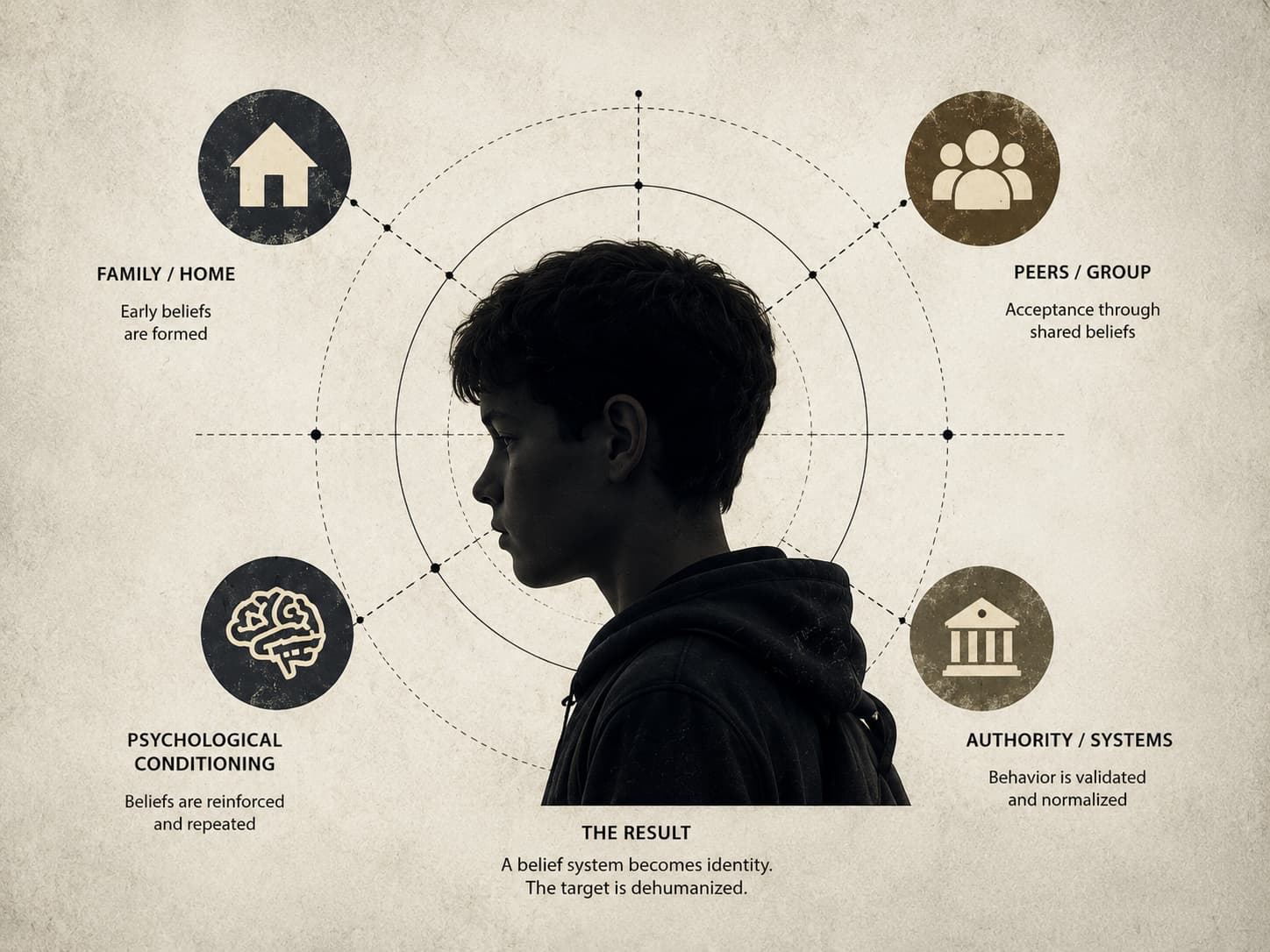
The first step to brainwashing is the home.
From my personal perspective, Generational Psychopathic Narcissists are created through early conditioning inside family and social environments where manipulation, harassment, intimidation, and emotional control are normalized from childhood onward.
In these environments, the child is not simply taught behaviors. They are taught a belief system.
What I refer to as the “Legitimized Belief System” is the process of convincing the child that the target deserves what is happening to them. The target is framed as dangerous, dishonest, guilty, inferior, unstable, criminal, or somehow responsible for the treatment they receive. This creates psychological permission for the harassment to continue without guilt or remorse.
The training often begins early by placing the child within the social sphere of the target. Over time, they learn how to observe, engage, follow, manipulate, and psychologically influence the target in ways that appear socially normal on the surface.
From my observations, these methods usually fall into two categories.
Engagement
The Engagement method is warm, social, and interactive. The goal is to establish some level of familiarity with the target.
- Saying hello repeatedly
- Starting unnecessary conversations
- Asking strange or random questions
- Appearing unusually friendly
- Creating repeated social contact
The purpose is to create the appearance of ordinary interaction. In this framework, even brief contact can later be used psychologically as justification that the behavior is “normal” and not harassment.
Indirect Proximity
Indirect Proximity operates differently. Instead of direct engagement, the participant remains physically present around the target without meaningful interaction.
- Walking near the target repeatedly
- Standing nearby without speaking
- Circling shared spaces
- Appearing in familiar environments
- Silently observing from a distance
In many cases, conversation is intentionally avoided. The purpose is presence without connection — creating awareness and environmental pressure.

Early Target Assignment
Children are introduced to targets early through schools, camps, workplaces, or family circles. Participants may be directed to observe, interact with, influence, or remain connected to the target over long periods of time.
Adult GangStalkers
Adults serve different functions within the system through structured environments and authority positions. Some may falsely imply ties to law enforcement to legitimize the behavior to younger participants.
Emotional Conditioning
The conditioning is psychological — rooted in narcissistic logic — as much as behavioral. Children raised in these environments are taught to lack empathy, hide intentions, avoid remorse, dismiss the target, and form parasitic attachments.
Cult-Like Reinforcement
Generationals often resemble members of closed belief systems or cult structures. They are surrounded by others who reinforce the same worldview from childhood onward.
“The behavior feels normal because it was normalized early.”
Emotional Conditioning: What They Are Taught
Lack of Empathy
The target “did something wrong,” so any suffering they experience is viewed as deserved.
Dishonesty as Protection
Participants may be taught to hide intentions, avoid direct answers, or maintain false identities to protect the system and its participants.
No Remorse
If something harmful happens to the target emotionally, socially, financially, or physically, the participant is taught not to feel guilt because the target is believed to deserve punishment.
Dismissal of the Target
If the target speaks about what is happening, they are labeled unstable, dishonest, paranoid, or confused. This allows participants to ignore the target’s experiences.
Parasitic Attachment
Participants may become psychologically dependent on following, studying, monitoring, or remaining connected to the target over long periods of time.